


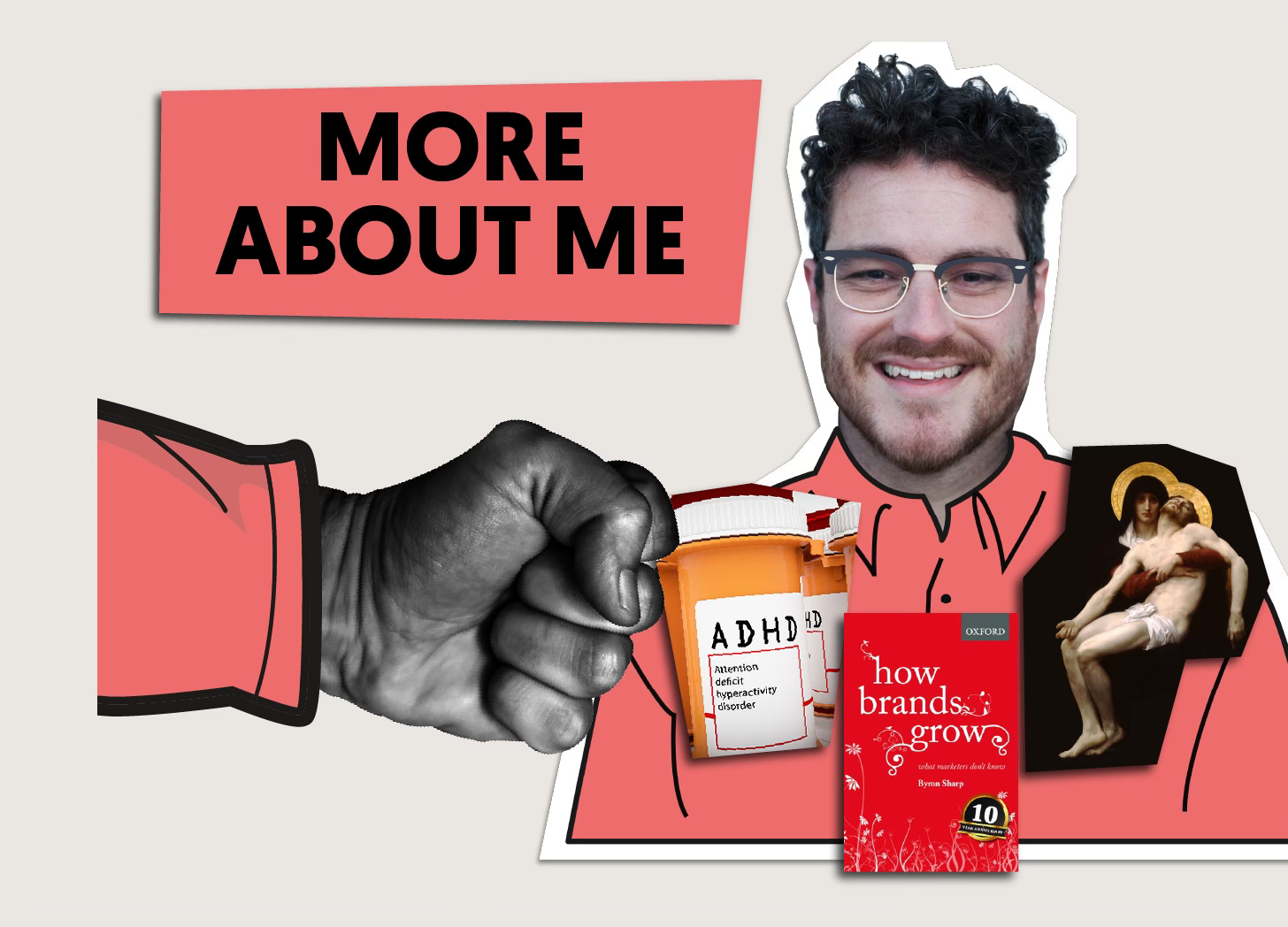
Recently, my subscribers quadrupled without me writing a single word. That’s when it occurred to me many of you don’t know much about me.
Before a few months ago, most of you knew me from LinkedIn and podcast appearances on Let’s Talk Branding and JUST Branding. And a random article I wrote about LinkedIn horseshit after a 3-year social media hiatus.
But Substack tells me that funnel has shifted. Three-quarters of you found me through my article, Design Has a “Brand Strategy” Problem, or because Substack recently developed a habit of recommending my newsletter to its newest, most unsuspecting members.
Before I get into my story, let me shamelessly plug myself.
How I Can Help Your Brand
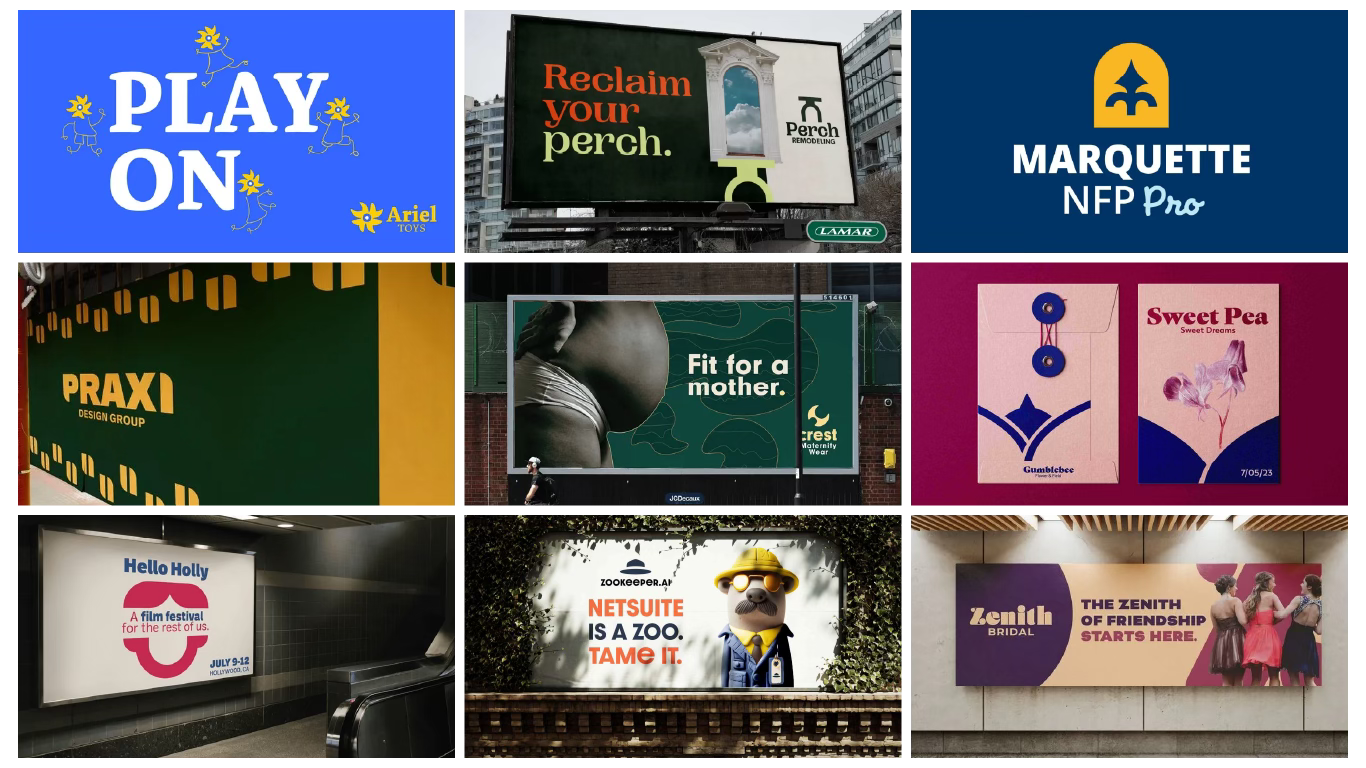
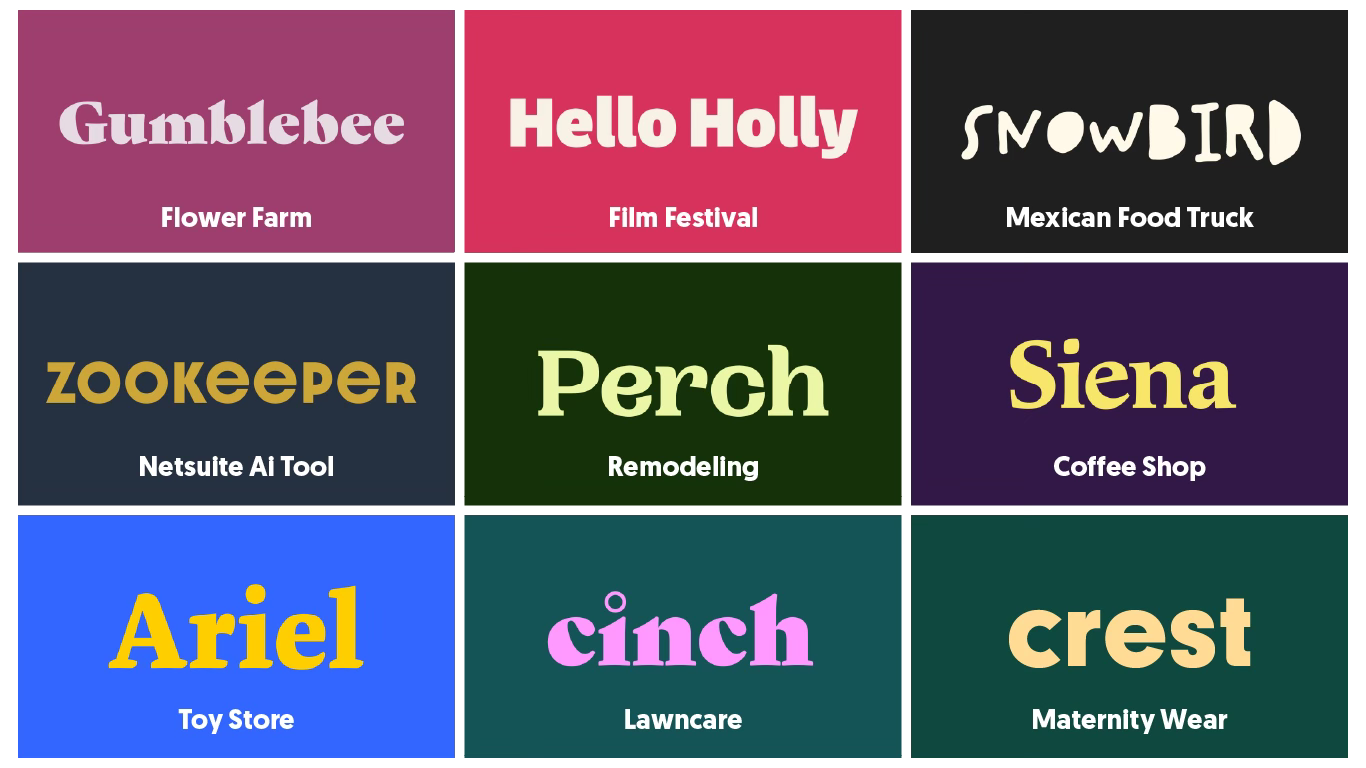
I help brands with naming and designing core distinctive assets: brand names, logos, mascots, package structures, jingles, sonic logos, taglines, color—you name it. If I can’t execute something myself, I’ll help you find the right idea and direct someone who can.
Asset Design
Naming
My approach differs from most. I don’t deal in pseudoscience—no color psychology, brand archetypes, or Maslow’s hierarchy. No week-long “design sprints” or “brand strategy workshops.” I look for inspiration everywhere except your category.
If you’re ready to build a more distinctive brand—or your agency is looking for a creative mind to join the team—let's talk about the right opportunity.
My philosophy and approach is explained in detail throughout the following three articles: Design Has a “Brand Strategy” Problem, Where “Meaning-Free Distinctiveness” Jumped the Shark, and Category-Defiant Distinctiveness in Action.*
If any of this resonates, you know where to find me.
Now—onto my story, and my secret weapon: ADHD.
I’ve Been on a Life-Long Hunt For Two Things: Truth & Beauty
Throughout most of my life, two of the three “transcendentals” have driven me: Truth and Beauty. I’ve only stumbled upon Goodness along the way.
First, Beauty. I’ve always been a creative. I spent half of high school in a TV production class, studied film in college, I’ve written music since I was a freshman in college, and I taught myself graphic design in 2016.
I’ve been interested in advertising for as long as I can remember. I even admired Darren’s job as an advertiser in Bewitched as a kid watching “Nick at Night.”
Right before I graduated college in 2011, I began taking my Catholic faith seriously for the first time—and Truth took over.
What pulled me in wasn’t beauty—which had been largely hollowed out of the U.S. Church in the 1970s as architects traded sacred art for a secular minimalism prescribed in a booklet called Environment and Art in Catholic Worship. It was my contrarian nature, combined with my upbringing as a nominal Catholic that pulled me in.
The most contrarian thing you can do in Arkansas is to either be an atheist or a Catholic. Protestant-Catholic hate there isn’t Northern Ireland in the 70s, but reveal your dark secret to a coworker and you’ll be condemned for idolatry on the spot.
After a series of events and friendships pushed me deeper into my faith, I grabbed every apologetics book I could find and discovered an intellectual side I never knew I had. Contrary to popular belief, reason is a central tenet of Catholicism. Each doctrine has been rigorously refined over two millennia by some of history’s most formidable intellectual minds.
By graduation, I’d lost interest in filmmaking and moved to Madison, Wisconsin. My first career was in ministry—four years traveling the country, consulting Catholic ministry staff and mentoring college students in prayer and virtue. Eventually I was tapped to handle all media for the nonprofit, re-learning filmmaking and teaching myself graphic design along the way.
Promotional videos were simple enough: travel the country, film people crying about how impactful we were—from a 70-year-old Oklahoma farmer to a Florida sorority girl.
But when asked to design a brand from scratch for a new online resource, I was lost. I can’t just show people crying in a logo. I had to figure out how brand design attracts users.
That’s when my background in apologetics and beauty collided with branding. Instead of obsessing over which theological arguments to deploy, I became obsessed with how design actually drives brand growth.
Initially, I turned to the obvious influencers—Chris Do, Marty Neumeier, Seth Godin, Simon Sinek, Donald Miller, even Gary Vee. Bought it all hook, line, and sinker. Used it to design my first brand.
Despite swimming in bullshit, it was still pretty damn distinctive.

I loved every minute of it. So much so, I quit ministry, struck out on my own, and pursued a career in identity design. But, my insecurity lingered and I was hungry for truth. I was terrified of designing a brand for a client that would turn around and fail them.
So, I got a library card and eventually stumbled upon a very unsexy white rabbit offline.
The Marketing Science Rabbit Hole
The book jacket is aggressively bad. Like, criminally bad. And yet, I picked up How Brands Grow anyway. That cover might be the sole reason most designers never stumble into marketing science. Designers aren’t putting early-2000s WordArt aesthetics on the bookshelf in their Zoom backgrounds.
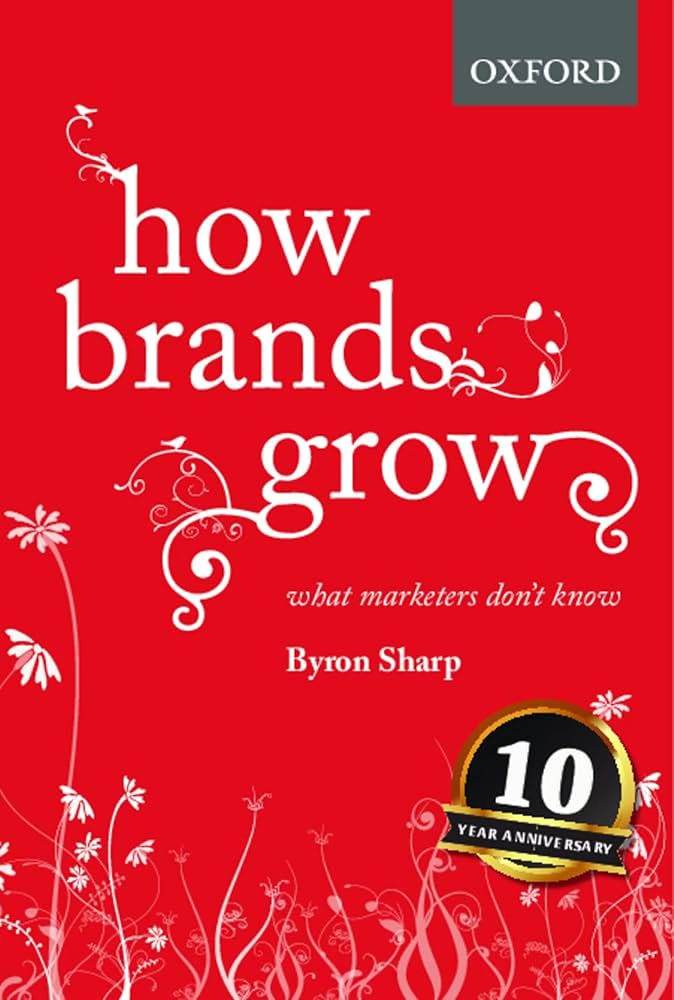

Once you get past the cover, Sharp’s ideas will rearrange your brain.
How Brands Grow is the antidote to Start with Why. Customers rarely “buy your why.” They don’t buy your story, your hustle, your “gut feeling,” or your 1,000-comments-a-day Instagram grind. They buy what’s familiar. They buy what they can find.
The contrarian in me was delighted.
How Brands Grow suggested brands must be designed for the most distracted brain in the room. Which happens to be me.
ADHD is a Disability, But a Useful One for Designers
I’m not going to tell you ADHD is a superpower. It’s a learning disability. I’m medicated for it. It has cost me plenty. But for brand identity designers and advertisers, there are advantages worth talking about.
It starts with an idea I’ve internalized since watching the documentary Objectified in 2019, but have never written about until recently. An idea stolen from physical product design: “designing for the extremes.”
When designing a vegetable peeler, you design the handle for someone with severe arthritis and a master chef. The product ends up working well for everyone in between.
In brand identity, designing for the extremes means designing for the most distracted brain in the room—and for design peers, marketers, and category enthusiasts who scrutinize every pixel. Nail both ends, and your brand works for everyone in between.
My ADHD puts me firmly at one of those extremes. And it’s taught me something I don’t think even the marketing science crowd has fully reckoned with yet.
Recently, I’ve started noticing that my peers—and even seasoned marketing scientists—frequently rate brands as distinctive when they aren’t, and praise advertising that teases the brand out until the end. For example, System1 Group has held up the 2025 Lay’s Super Bowl ad as a masterclass in brand codes.* The Lay’s brand didn’t appear until 43 seconds in…
The problem is that System1 is testing ads in an isolated lab setting with viewers’ full attention, then asking them soon after what brand was advertised. That’s not how most advertising is experienced. Most advertising is experienced while distracted. While scrolling. While arguing with your kids. While doing literally anything else.
ADHD has complicated a lot of my life, but not my design work. It’s clarified it. But ADHD isn't the only thing that's put me at an extreme most designers never occupy. My Catholic faith also allows me to design for the extremes.
*Admittedly, Lay’s is far more synonymous with potatoes than anyone else, which likely explains why the fluency scores for this ad were unusually high when the only clues to the brand or category are yellow boots and a potato. However, unless you hold total market dominance and are airing during the Super Bowl—where audience engagement is at its peak—I wouldn't recommend relying on such subtle cues before revealing your brand.
How My Catholic Faith Helps Me “Design for the Extremes” and Reach All Category Buyers
Byron Sharp’s How Brands Grow is a mandate for radical reach: if you want to scale, you have to talk to everyone—especially the people who barely know you exist. Most marketers fail at this because they are trapped in a cultural bubble. I’ve found my escape hatch in a 2,000-year-old "design for the extremes" framework that is stubbornly non-partisan: my Catholic faith.
Catholicism is not tied to a single political ideology. I’ve heard it said that Jesus was the most conservative person to have ever lived and the most liberal.
Jesus explicitly condemned extramarital sex. He located the root of evil in the human heart, not in systems or structures. He wasn’t “inclusive” or “tolerant” in any modern therapeutic sense—he declared that no one comes to the Father except through him. He didn’t traffic in “your truth” or “my truth.” He claimed, with unsettling directness, to be the truth. And he preached radical forgiveness—something cancel culture, on both the left and the right, has made its business to destroy.
But he also confounds the other side completely. He rejected what we’d now recognize as core MAGA commitments: cruel treatment of immigrants, the idol of personal liberty over the common good, an appetite for punishment, nationalism. He ate with prostitutes. He preached a preferential option for the poor and powerless. He told a rich young man to sell everything. He boldly proclaimed you have to lose your life to find it. To turn the other cheek.
To put it frankly, JD Vance is a bad Catholic. And so is Joe Biden. But, so am I half the time. The Church doesn’t fit on a bumper sticker. Which is exactly why it’s useful to me as a designer who dabbles in advertising.
I’ve spent my career straddling two worlds that don’t talk to each other: predominantly conservative, working-class communities in two different states, and the left-leaning, intellectually insular world of professional marketing. Most people in my industry only ever live in one of those worlds. That’s a problem, because your category buyers live in both.
That vantage point is why I can see “social purpose” campaigns for what they usually are: tone deaf and exclusive. It’s why I notice that Cannes Lions darlings couldn’t sell to a broad category buyer if their lives depended on it. It’s why I watch “dopamine design” alienate buyers outside a small trend-chasing demographic while designers congratulate each other.
And it’s why I stopped taking seriously the Gen Z surveys claiming that the vast majority of young consumers “fight for justice” and buy brands that share their values. I’ve watched my 20-year-old nephew laugh at TikTok videos of Joe Biden falling down stairs and my niece buy from Shein as a broke high school student. You are living in a fantasy if you think a generation raised on social media is more virtuous when they aren’t chasing likes online.
Designing for all category buyers means you can’t live inside one tribe. My faith—stubbornly and inconveniently unclaimed by either party, that simultaneously lives in the extremes of both—has kept me from doing that.
I started this newsletter trying to help brands “attract the customer of their dreams.” The dream customer. The ideal buyer. The one who gets you.
It took a library card, a learning disability, and my Catholic faith to teach me the real job: reach everyone else too.
Okay. Enough brand design talk.
I figured some of you might want to know more about me beyond my career. So, I’ll use the end of this article as an excuse to resurrect my Myspace page from college, but with updated favorites and stripped of drunken pictures of myself.
My Favorite Things:
Favorite People: My wife and two daughters.
Favorite Musicians (along with links to my favorite songs of theirs)- Son Lux, M83, Miles Davis, Bon Iver, Elliot Smith, Sufjan Stevens, The Antlers (their concept album, Hospice), Andrew Bird, The Arctic Monkeys, Colour Revolt (I got to interview them and filmed this impromptu concert in a green room for a college TV show), Dr. Dog, Explosions in the Sky, Sigur Ros, Gregory Alan Isakov, The Postal Service, Wolf Parade
Favorite Films - Narrative: Jaws, The Departed, The Shining, In Bruges, Seven Psychopaths, It’s a Wonderful Life, Whiplash, Rear Window, No Country for Old Men, North by Northwest, The Exorcist, Her, The Birds, Stepbrothers, Submarine
Documentaries: The Act of Killing, Paradise Lost, Man on Wire, Waiting for Superman, Won’t You Be My Neighbor, Life in a Day
Favorite Brands - These are the brands I might purchase new offerings from without second thought: Output (music software), A24 (film studio), Bob Hoffman (does a person count?), Ehrenberg-Bass Institute.
And the brands I respect for their marketing and identity design: Geico, State Farm, Pringles, Dunkin, Pirateship.com, Liquid Death (even as a LinkedIn contrarian I gotta respect what they’re doing).
And the only brands I would say I’m “in love with” and “identify with”: the Catholic Church, Franke’s Cafeteria (my family’s restaurant which closed in 2020 after 101 years).
Favorite Saints - Maria Goretti (radical forgiveness), Ignatius of Loyola (practical spiritual advice), John Paul II (an intellectual powerhouse and lover of Beauty), Joseph (an example of a father, husband, and worker)
Favorite Work of Art - William-Adolphe Bouguereau’s Pietà.
Bouguereau painted the Pietà seven years after his four-year-old daughter died, and in the same year his 15-year-old son died. You can tell.
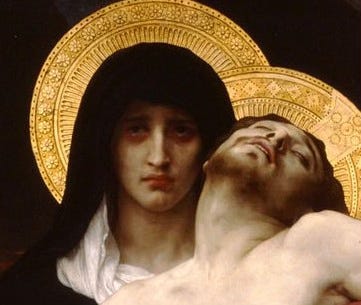
The painting is deliberately ambiguous: is Mary looking at the viewer, or at the heavens? What’s unmistakable is the contempt in her face. The subtle curl of her lip, the swollen eyes. Contempt for those who killed her son, for the collective sin of the world, and perhaps for God himself. Catholics believe Mary was conceived without sin, but sinless doesn’t mean unfeeling.
Meditating on Mary's face in this painting during a silent retreat was the first time she felt real to me. Not the sanitized, perfectly serene Mary of greeting cards—but a woman who had watched her son be executed, and whose face Bouguereau refused to clean up. I've come to call that expression "righteous contempt," and I know it well. I've felt it and I've earned it from others.
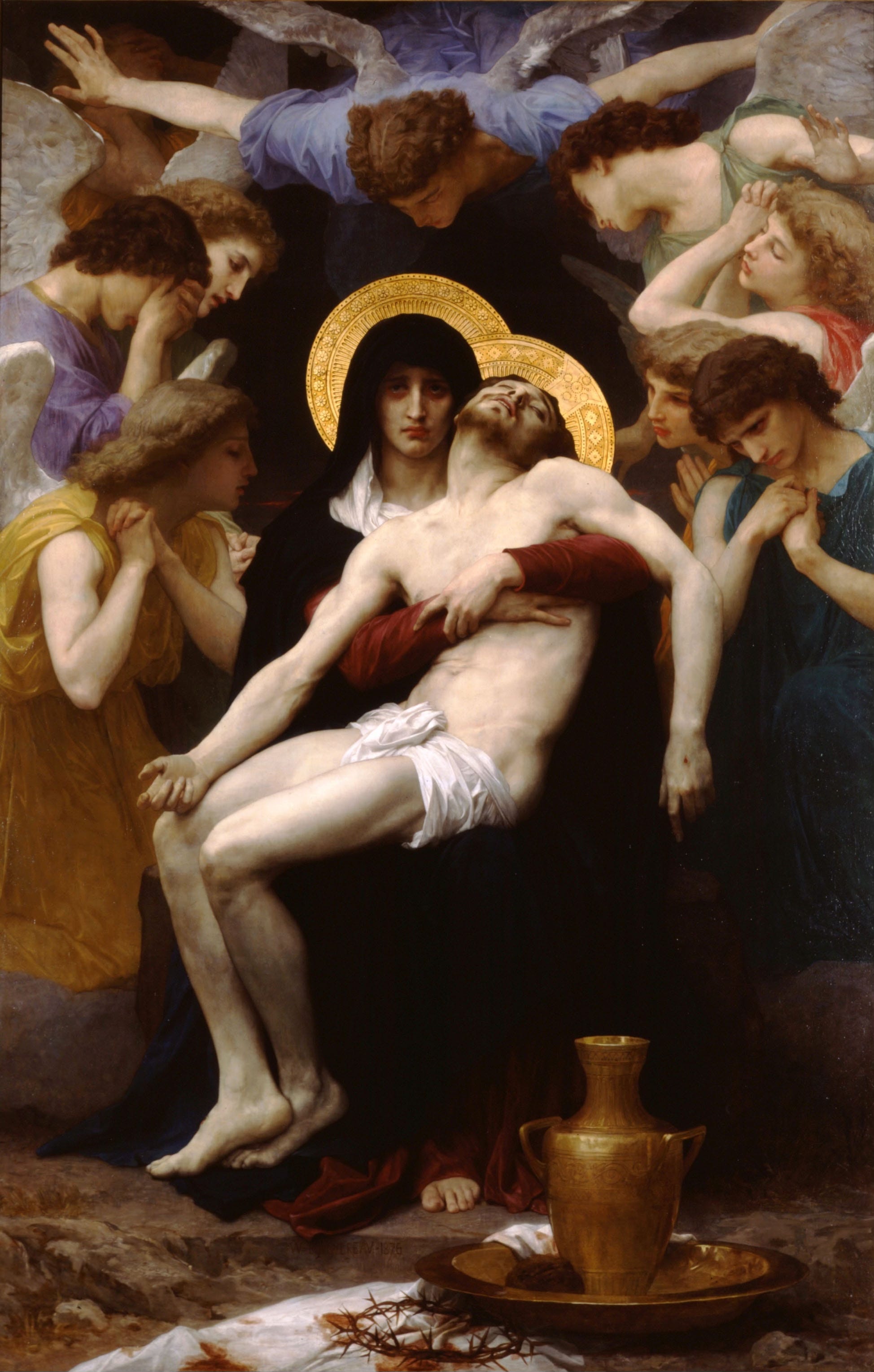
Less than two years after the Pietà, Bouguereau’s wife died of tuberculosis, followed two months later by their seven-month-old son. He would outlive one more child—an adult son, dead at 32. Of his five children, only one survived him.
His faith never broke.
So, there you have it! Let me know in the comments if you want more personal content like this from time-to-time.